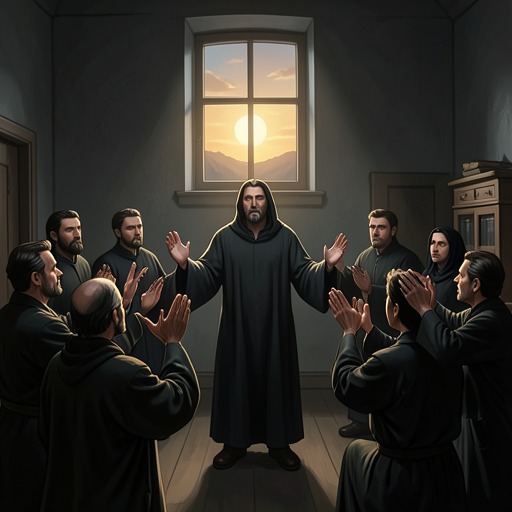
The Manson Family’s view of fear as a trial
Once Upon a Time in HollywoodThe Manson Family’s view of fear as a trial transforms fear from an obstacle to be escaped into the measure of whether a person can be made to face it alone. In Charles Manson’s coaching of Debra Jo Hillhouse, the doctrine is both a ritual of supposed self-overcoming and an exercise in control: he defines the test, interprets her trembling, and presents obedience to his guidance as a route to personal power.
A doctrine built around the solitary test
The test begins outside a dark house, where Charles Manson stands behind Debra Jo Hillhouse with his hands on her shoulders. He tells her it is her time to “face fear,” and insists that she undertake the task by herself. She points out that this is not her first “kreepy krawl”; his answer distinguishes this attempt from the earlier ones because she has never done it alone. The difference is central to his teaching. The Family, he explains, draws strength from numbers, but collective strength does not replace what he calls individual achievement: testing oneself by facing fear alone.
The doctrine contains a revealing tension. Charles Manson describes the task as something Debra Jo Hillhouse must do for herself, not for him or the other members watching. Yet he is the one who selects the test, declares that she must face it, and tells her what its meaning will be. When he asks why she wants to do it, she answers that it is because he wants her to. He agrees that he does want it, then redirects her toward the language of self-motivation. The professed aim is independence; the authority to define that independence remains his.
Fear as a method and a ritual
Charles Manson gives the fear trial a memorable formula: “Fear is the point. Without fear, there is no point.” He claims that almost everyone spends most of life running away from fear, while Debra Jo Hillhouse is walking toward it. The statement makes fear itself—not the discovery of anything particular inside the house—the standard by which the test is judged. Success is framed as approaching what frightens her, rather than avoiding it.
The instructions make this idea bodily and specific. After the door moves, Debra Jo Hillhouse catches her breath and realizes she will have to enter. Charles Manson’s imagined voice guides her through the next stage: set aside the ego, cease to exist, and move on all fours like a cat exploring a house. She crawls through the partly opened sliding door, crossing the kitchen linoleum into the living room. The catlike posture turns self-erasure into the practical technique of the trial: she is to suspend ordinary self-presentation and act as a creature investigating unfamiliar space.
The procedure also contains a safety measure. Charles Manson tells her to leave the sliding door open in case she needs to make a quick escape. That instruction complicates the image of a test based on fearless surrender. The ritual asks her to enter, but it does not require her to eliminate every means of retreat. Fear is to be approached under conditions he has arranged and narrated for her, with an exit preserved at his direction.
Intimacy, reassurance, and authority
The scene presents Charles Manson’s influence not as instruction alone but as intimate reassurance. He notices Debra Jo Hillhouse trembling and names the fear she denies. When he asks whether she trusts him, she says that she does and tells him she loves him. He answers in kind, then describes his love as what nudges her toward greatness. The encouragement binds the challenge to their relationship: the person urging her forward is also the person whose approval and affection she openly affirms.
Her name sharpens that bond. Charles Manson is the only person besides her father whom she still allows to call her by her birth name rather than her adopted one. In the scene, he moves between that name and the cat identity he has made central to the task. He tells her that he is within her heart and body, then embraces her from behind as they sway together. The language of becoming powerful is thus delivered through a relationship in which he claims unusual access to her identity and inner life.
He promises that the girl who emerges from the house will be vastly more powerful than the girl who entered it. After the embrace, he steps back and slaps her behind to send her forward. The transition from whispered reassurance and physical closeness to a sharp gesture of propulsion condenses the method: affection makes the ordeal feel intimate, while Charles Manson’s authority determines when she must move. The trial is presented as her achievement, but its emotional and physical staging belongs to him.
The wider pattern of fear and masculine status
Elsewhere, the book places fear and vulnerability beside public performances of masculine confidence. Rick Dalton complains about the hippies on the sidewalk and imagines them lined up and shot; soon afterward, on the drive home, he declares himself a has-been and describes his career as a descent from ascent through stagnation to a race downward. The contrast shows that loud hostility and private fear can occupy the same man. Rick’s fear is tied to professional decline, while Charles Manson turns fear into a deliberately assigned test for a younger follower; the scenes do not make these experiences equivalent, but they place different responses to vulnerability within the same Hollywood landscape.
Cliff Booth likewise interrupts Rick Dalton’s assumption that a trip to Rome to star in films would be a fate worse than death. He clarifies that he is no longer Rick’s stunt double in practice but his driver and gofer, while saying he likes the work and does not regard the Italian-film prospect as Rick does. In another account of his life, his survival after escaping a Japanese prisoner-of-war camp leaves him uncertain what to do next; time in Paris introduces him to the profession of pimping, whose methods of manipulation he studies. These episodes do not state the Family’s doctrine, but they supply a counterpoint to its language of fear and self-mastery: masculine identity in the book is also shaped by lost roles, survival, and efforts to gain control over others.
The contrast continues in the account of the Bruce Lee Incident, described as a friendly contest and the most infamous set fight in Cliff Booth’s career. Rick Dalton’s drinking, by contrast, is attributed to self-loathing, self-pity, and boredom. At the end of the book, Rick recalls the work, people, travel, and comforts his career brought him, then recognizes his good fortune and tells Trudi Frazer that actors are lucky. Together, these episodes keep the idea of fear from becoming a universal explanation: the novel shows several forms of insecurity and response, while the Manson Family’s particular doctrine makes fear a trial whose terms Charles Manson controls.